I just wrapped up my first week as Director of Membership & Community at HICAM, the Hayes Innovation Center for Advanced Manufacturing. And I gotta say, it feels like coming home. That’s really the best way I can put it.
If you’re not already familiar with HICAM, it’s a 52,000 sq ft campus in East Austin built for advanced manufacturing, robotics, and embodied AI startups. There’s a serious prototyping space, training programs, and an ecosystem that connects founders to corporations, academic partners, and each other. It’s exactly what Austin’s hardware community has been missing.
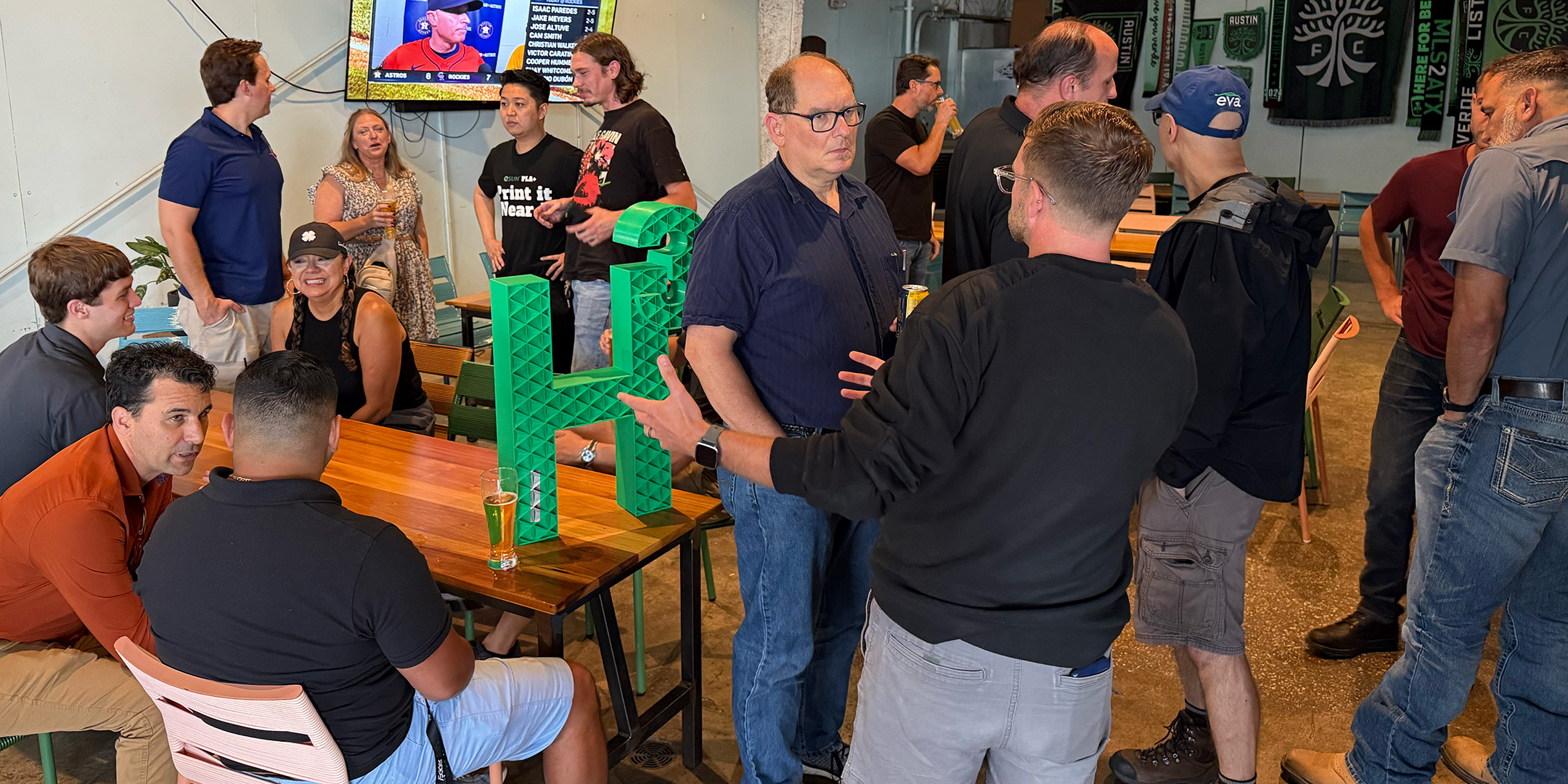
For anyone who’s caught me at H³ ATX or one of the other hardware meetups I help organize, this won’t come as much of a surprise. I’ve spent years connecting hardware founders to the right people, tools, and resources, first through through the accelerators I’ve led, then 0112 Studio, and just by showing up in this community over and over. HICAM gives me a home base to keep doing that work, at a scale I haven’t had access to before.
Huge thanks to Marcus Metzger, Lorna Nash, Jamie Harkrider, and Cash (the dog) for being so welcoming this first week. I’m looking forward to everything ahead with this crew.
If you’re building in hardware, robotics, or embodied AI in Austin, or thinking about starting, I’d love to hear what you’re working on. Come find me at HICAM.
There’s a type of founder I keep running into. They’ve built something real, technically sound, often impressive, and they’ve been heads-down for long enough that the business stuff has quietly piled up in the corner. Not ignored, exactly. Deferred. There’s a difference, though it doesn’t always feel that way when you finally turn around and look at it.
I’ve spent the better part of two decades watching this pattern play out in hardware accelerators in New Zealand and Austin, as well as in the product work I’ve done alongside technical teams over the past few years. The engineering problem gets solved. The clarity problem doesn’t. And clarity about who you’re building for, what the product actually is, how decisions get made, tends to matter a lot when you’re trying to go from “thing that works” to “business that works.”
I have two client spots open in June. If you’re a technical founder who’s ready to do the work of actually building and validating the business, not just the product, the 12-week program might be worth a conversation. We work through the stuff that’s easy to defer but you shouldn’t: translating your technical depth into genuine product-market fit clarity, building the systems and habits that hold up as things scale, and making decisions from strategy rather than just urgency.
One thing I’ll mention because I find it genuinely useful… you walk away with more than a clearer head. You get a structured repo of markdown files, your strategy, your systems, your key decisions, in a format that your AI agents and tools can actually work with. Not just documentation for documentation’s sake. A second brain you can build on.
This isn’t a coaching subscription. It’s a structured 12 weeks with real outcomes on the other side.
I’m booking through Proton these days (yes, the encrypted email folks, some cyberpunk habits die hard). You can find a time at 0112.studio/chat.
If you know a technical founder who might need this, feel free to pass it along.
Smart founders. Good products. Teams that had already solved hard problems. But nobody had ever forced them to stop and ask the questions that would determine whether any of it survived contact with the real world.
Who exactly will pay for your solution? Do the unit economics hold at any realistic volume? What certifications do you need before you can legally sell a single unit?
I’ve spent two decades helping founders build the right things — through New Zealand’s first hardware accelerator, through Army Futures Command’s hardware accelerator at the Army Applications Laboratory, and across products in HealthTech, IoT, and beyond. And the pattern I’ve seen more than any other is this: the product wasn’t the problem. The questions nobody asked were.
Why Founders Skip This
Hardware founders are problem-solvers. You’re wired to move fast, trust your instincts, and build your way through uncertainty. That’s not a flaw… it’s exactly what the job requires.
But that same instinct can make formal strategy work feel slow, generic, and disconnected from the real work of building. Most frameworks don’t help because they weren’t built for hardware. They have no idea what a BOM is. So founders skip them, and the gaps stay hidden until they’re expensive.
What I Did About It
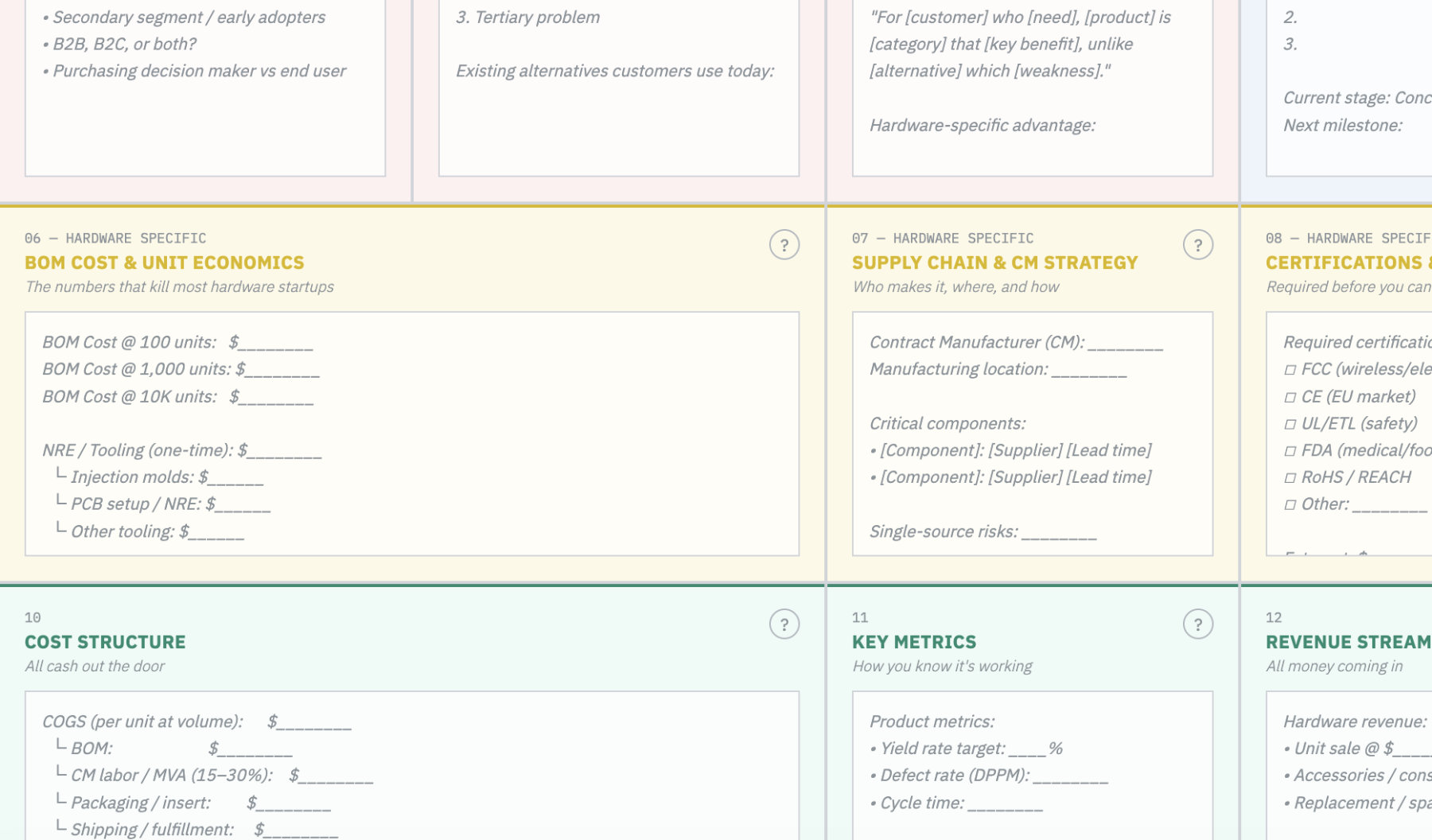
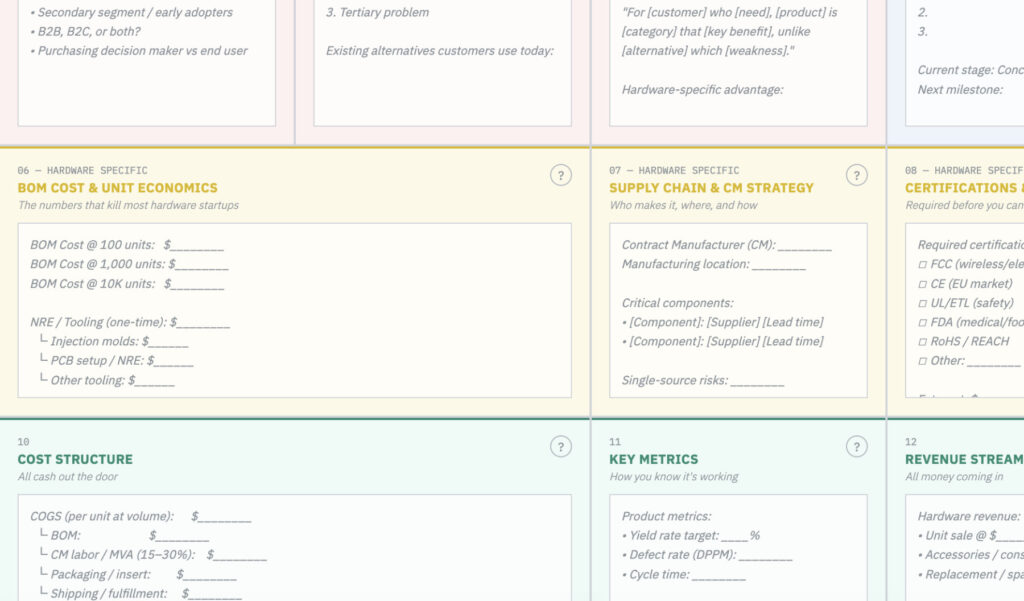
The Hardware Startup Canvas is a 12-section strategic planning tool built specifically for physical product companies. It covers the sections most frameworks skip entirely — unit economics, supply chain and CM strategy, certifications and compliance — alongside the fundamentals every startup needs to work through.
It’s not about slowing founders down. It’s about applying the same rigorous thinking that makes great hardware founders exceptional to the business itself.
The Workshop
I run a live, 2-hour working session for small groups of founders to fill out the canvas together, in real time. You leave with your biggest risks named, a 30/60/90-day plan to address them, and a free AI audit tool to use again and again.
If you’re building a physical product at any stage, this is the exercise I wish someone had put me through earlier.
Running hardware accelerators in New Zealand and Austin, I watched a pattern emerge that was hard to unsee.
The founders who came through our programs were sharp. Technically capable. Often brilliant. And they almost always had products that actually worked. What they didn’t always have was a business that worked around the product.
The engineering problem got solved. The customer demand didn’t. The unit economics looked fine on a whiteboard, then fell apart at 500 units. The certification timeline got underestimated by six months. A channel strategy that worked for software got applied to something physical and stalled.
These aren’t random bad luck. They’re predictable failure modes. And they show up, repeatedly, in early-stage hardware companies that haven’t built the right foundation before scaling.
The Problem with Generic Frameworks
Business model tools like the Lean Canvas and Business Model Canvas were built for software-first companies. They’re excellent at what they do, but hardware is a different problem.
Software has no BOM. It doesn’t have a contract manufacturer, a certification process, or a supply chain that can be disrupted by a single component shortage. It doesn’t require you to forecast tooling costs, navigate FDA or FCC requirements, or decide between direct-to-consumer and retail distribution before you’ve shipped a single unit.
When hardware founders try to use generic frameworks, the result is a plan that looks complete but has gaps where the hard stuff should be. Those gaps surface later. Usually at the worst possible time.
What the Canvas Addresses
The Hardware Startup Canvas is built specifically for physical product companies. It covers the twelve areas that matter most at the early stage, including ones that rarely appear in standard frameworks:
Bill of Materials and unit economics. What does it actually cost to build? How does that change at 100, 1,000, and 10,000 units? The BOM is where most hardware businesses either work or don’t. It needs to be stress-tested early, not discovered late.
Supply chain and contract manufacturing strategy. Who makes it, where, and what happens if they can’t? Single-source dependencies and long lead times are among the most common reasons hardware companies miss their windows.
Certifications and compliance. FCC, CE, UL, FDA. Depending on what you’re building, the certification path can take months and cost more than the first prototype. Founders who treat this as a checkbox at the end often find themselves six months from launch with no clear path to market.
These sit alongside the fundamentals — customer segment, problem, unique value proposition, channels, cost structure, key metrics, and revenue streams — all framed around the specific realities of hardware.
Built for Clarity, Not Complexity
The canvas is a single page. The goal isn’t a 40-page business plan. It’s to force the right conversations early, surface the assumptions that need testing, and give founding teams a shared view of where they are and what’s unresolved.
It works as a starting point for a new venture, a checkpoint before a funding round, or a diagnostic when something isn’t working and you need to figure out why.
The canvas is free at hardwarestartupcanvas.com. Fill it out in the browser, export a PDF, and/or get a formatted version sent to your inbox.
If you’re working through it and want a second set of eyes — that’s exactly what I do at 0112 Studio.
Update: I’ve now launched a new paid feature for the Hardware Startup Canvas — an AI audit delivered directly to your inbox. Some pretty cool insights and recommendations actually. Check it out if/when you get the chance.
A couple of years back, in what I described at the time as a “wide open” moment (translation: professionally uncertain), I quietly dropped a link in a post here to something called 0112machine.shop.
Didn’t really say much about it. Just let it sit there, a placeholder for ideas that hadn’t quite crystallized yet. Well, the placeholder phase is officially over.
Today I’m launching 0112 Studio — an AI native product studio and rapid prototyping practice built around a question I’ve been asking for most of my career: what’s actually worth building?
For 14 years at SXSW, I helped shape what a technology event could be and watched ideas become movements. Running hardware accelerators in New Zealand and Austin, I watched passionate founders pour everything into products that sometimes thrived and sometimes didn’t. Working alongside software and hardware product teams over the past few years, I’ve helped businesses de-risk the build before fully committing to the investment.
The industries change. The businesses change. The question never does.
I’m launching with three sprint offerings, each designed to work independently or as part of a larger sequence:
01 — Signal from Noise: AI Clarity Sprint – From AI ambiguity to an executable plan in 10 days.
02 — 0→1: Rapid Prototyping – From idea to working prototype in less than 2 weeks.
03 — Confirm the Signal: Customer Validation Sprint – From working prototype to validated product direction.
Start with clarity. Then build. Then validate. Simple in concept, and harder than it sounds to actually pull off — which is exactly the point.
I have capacity for a small number of new engagements starting in April. If the timing is right for your team, I’d love to connect.
Head over to 0112.studio to learn more. Can’t wait to see what we build together.
It’s wild to think that since our very first H³ ATX event back in December 2022, Riley Knox, R. D. Childers and I have co-organized 27 hardware happy hours (if my math is correct) — each at a different venue in the Austin area.
A huge thanks to everyone who shows up each first Thursday of the month to share ideas, swap stories, and explore what’s possible together in hardware & deeptech. Our 28th edition is this Thursday, September 4th at Meanwhile Brewing on the southeast side of town. Hope you can join us.
For details on future events, make sure to join the H³ ATX email list. Not to worry — we’re very gentle on the old inbox.
Recently, I took a deep dive into the archives and dusty stacks of storage boxes to reveal an unexpected and hidden treasure. Not gold bullion or a rare stamp collection, but the last remaining batch of t-shirts from Rock That Font — the (now archived) blog dedicated to the intersection of typography and rock’n’roll.
Originally printed in 2014 in Austin by our pals at Industry Print Shop, these NOS (new old stock) tees are pretty much vintage at this point. The monochromatic, dark blue (Pantone 7546) on Indigo (Next Level Tri-Blend) Rock That Font t-shirt keeps things soft, subtle, and classy. Fellow font nerds will no doubt inquire about the custom typeface designed by Rock That Font co-creator and contributor, Eric Hurtgen.
Want to get your hands on one for FREE? Just shoot me a note with your snailmail address and I’ll get one headed your way.
Limited sizes are available, but let me know your preference. Venmo donations to cover shipping are kindly appreciated.
I remember renting a bunch of SM57s, a 16-channel Mackie mixer, and an 8-track ADAT machine (16 bit!) from Rock’n’Roll Rentals in Austin, Texas. With production assistance from best mate Chadwick Smith, we wired all the above gear together and recorded 10 songs in a carpet-insulated room that had once been a garage.
It was the summer of 1998.
I was 23 years old.
Red Boxing was a band named after the red box tone generator in phone phreaking, a type of hacking (that I may or may not have engaged in) before telephone systems went fully digital.
In any case, I sang and played the guitar.
Longtime friends Urny Maxwell (vox/guitar), his brother Yogi Maxwell (drums), Mitch Clark (bass) and I had known each other for years and performed in various bands/lineups around this time. (Urny and Yogi would go on to form Cruiserweight not long afterwards.)
Big thanks to Yogi for surprising us with this effort to get all the tracks online and archived. I hope we correctly recalled all the song titles — it’s been quite a few years and the memory has certainly faded with time.
Here’s the full tracklist of the resurrected songs, for anyone who wants to dig in:
1. Remote Sensing
2. Into the Stratosphere
3. Dirt is Our Candy
4. On Strike*
5. Language and Genome*
6. Good News for the Standard Model*
7. Come Let Me Down
8. Continent
9. Untitled / Bonus Track
10. Scopic Drive*
* indicates the 4 songs released on a small run of demo cassettes in 1999.
For me, these songs are a time capsule, a snapshot of who we were and how we were having fun in the post-punk, math-rock, emo-ish scene of the late ’90s in Austin. For you, whether you were there with us back in the day or are hearing Red Boxing for the first time, I hope these songs bring a little of that same nostalgia.
Recently, Riley from Accelerate3D and I were attending a local demo day and nerding out on the latest developments in additive manufacturing (meaning, I was bugging him about which 3D printer I should pick up next). We discussed Austin’s fragmented innovation community, particularly when it comes to hardware entrepreneurship. We discussed the fact that Austin was built by hardware companies, despite the stories that dominate tech bro conversations and culture — and many more wonderful topics of discussion with the handful of hardware nerds in attendance.
Then we decided to do something to enable more of these inspirational conversations…
Are you looking to connect with like-minded hardware enthusiasts? Then join our ragtag group for beers, intriguing conversations & other shenanigans at the inaugural H³ ATX.
H³ ATX (Hardware Happy Hour – Austin) is a free networking event for hardware entrepreneurs and enthusiasts, occurring on the 1st Thursday of every month in a different location.
This Thursday, December 1st, we’ll be gathering at Brewtorium around 5pm. First round is on me.
Twenty-five years ago, the primary focus of my life was to create music. As a singer/guitarist and audio engineer, I had a full studio stuffed into my little apartment. An array of guitars and amps littered my bedroom, along with effects pedals, reel-to-reel machines, a church organ, an upright piano (bought from Goodwill), and a few vintage drum kits to boot. There was hardly room for a bed.
These days less is certainly more. And technology has come a long way to help facilitate a more minimalist approach when it comes to the number of instruments required to make music.
However, during the pandemic I returned to creating music and picked up a pair of drumsticks for the first time in over two decades. I overcame my trepidation and embraced the therapeutic benefits of drumming — as well as all the shit to carry that comes with the fun of percussion.
If you’re in Austin this weekend, come see me perform classic country/blues/rock’n’roll at the strangely-named Hairy Man Festival. And if you’d like to learn of more upcoming gigs along these lines, feel free to join the Austin Prairie Dogs mailing list at austinprairiedogs.com.