Category: Updates

  • Two Spots for Transformation in June

    Two Spots for Transformation in June

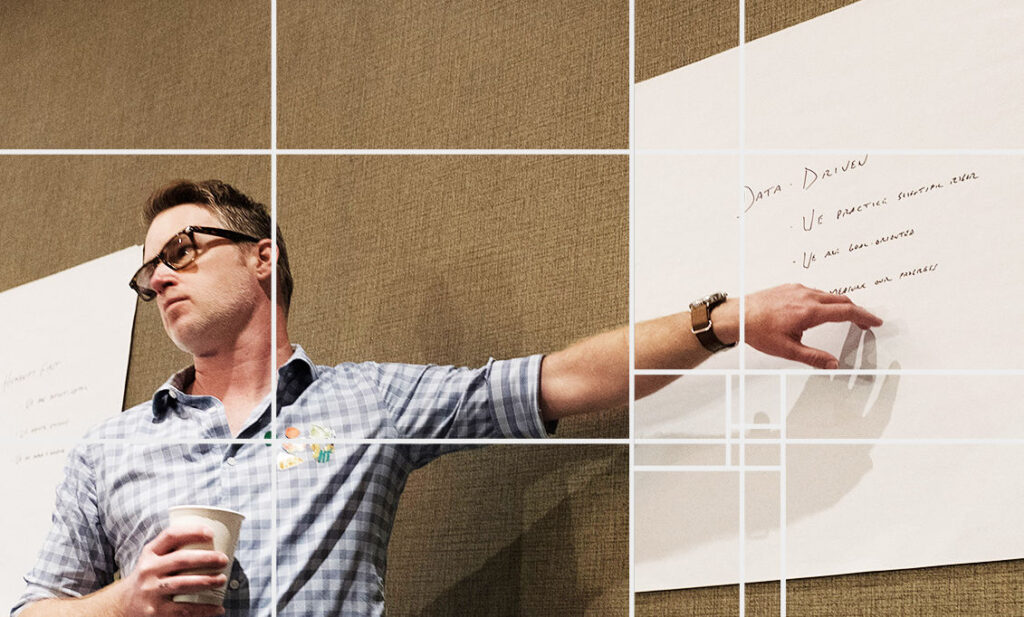
    Fibonacci sequence

    There’s a type of founder I keep running into. They’ve built something real, technically sound, often impressive, and they’ve been heads-down for long enough that the business stuff has quietly piled up in the corner. Not ignored, exactly. Deferred. There’s a difference, though it doesn’t always feel that way when you finally turn around and look at it.

    I’ve spent the better part of two decades watching this pattern play out in hardware accelerators in New Zealand and Austin, as well as in the product work I’ve done alongside technical teams over the past few years. The engineering problem gets solved. The clarity problem doesn’t. And clarity about who you’re building for, what the product actually is, how decisions get made, tends to matter a lot when you’re trying to go from “thing that works” to “business that works.”

    That’s the gap I work in at 0112 Studio.

    I have two client spots open in June. If you’re a technical founder who’s ready to do the work of actually building and validating the business, not just the product, the 12-week program might be worth a conversation. We work through the stuff that’s easy to defer but you shouldn’t: translating your technical depth into genuine product-market fit clarity, building the systems and habits that hold up as things scale, and making decisions from strategy rather than just urgency.

    One thing I’ll mention because I find it genuinely useful… you walk away with more than a clearer head. You get a structured repo of markdown files, your strategy, your systems, your key decisions, in a format that your AI agents and tools can actually work with. Not just documentation for documentation’s sake. A second brain you can build on.

    This isn’t a coaching subscription. It’s a structured 12 weeks with real outcomes on the other side.

    I’m booking through Proton these days (yes, the encrypted email folks, some cyberpunk habits die hard). You can find a time at 0112.studio/chat.

    If you know a technical founder who might need this, feel free to pass it along.
  • The Question I Wish Someone Had Asked Me Earlier

    The Question I Wish Someone Had Asked Me Earlier

    I made the Hardware Startup Canvas because I kept watching the same thing happen.

    Smart founders. Good products. Teams that had already solved hard problems. But nobody had ever forced them to stop and ask the questions that would determine whether any of it survived contact with the real world.

    Who exactly will pay for your solution? Do the unit economics hold at any realistic volume? What certifications do you need before you can legally sell a single unit?

    I’ve spent two decades helping founders build the right things — through New Zealand’s first hardware accelerator, through Army Futures Command’s hardware accelerator at the Army Applications Laboratory, and across products in HealthTech, IoT, and beyond. And the pattern I’ve seen more than any other is this: the product wasn’t the problem. The questions nobody asked were.

    Why Founders Skip This

    Hardware founders are problem-solvers. You’re wired to move fast, trust your instincts, and build your way through uncertainty. That’s not a flaw… it’s exactly what the job requires.

    But that same instinct can make formal strategy work feel slow, generic, and disconnected from the real work of building. Most frameworks don’t help because they weren’t built for hardware. They have no idea what a BOM is. So founders skip them, and the gaps stay hidden until they’re expensive.

    What I Did About It

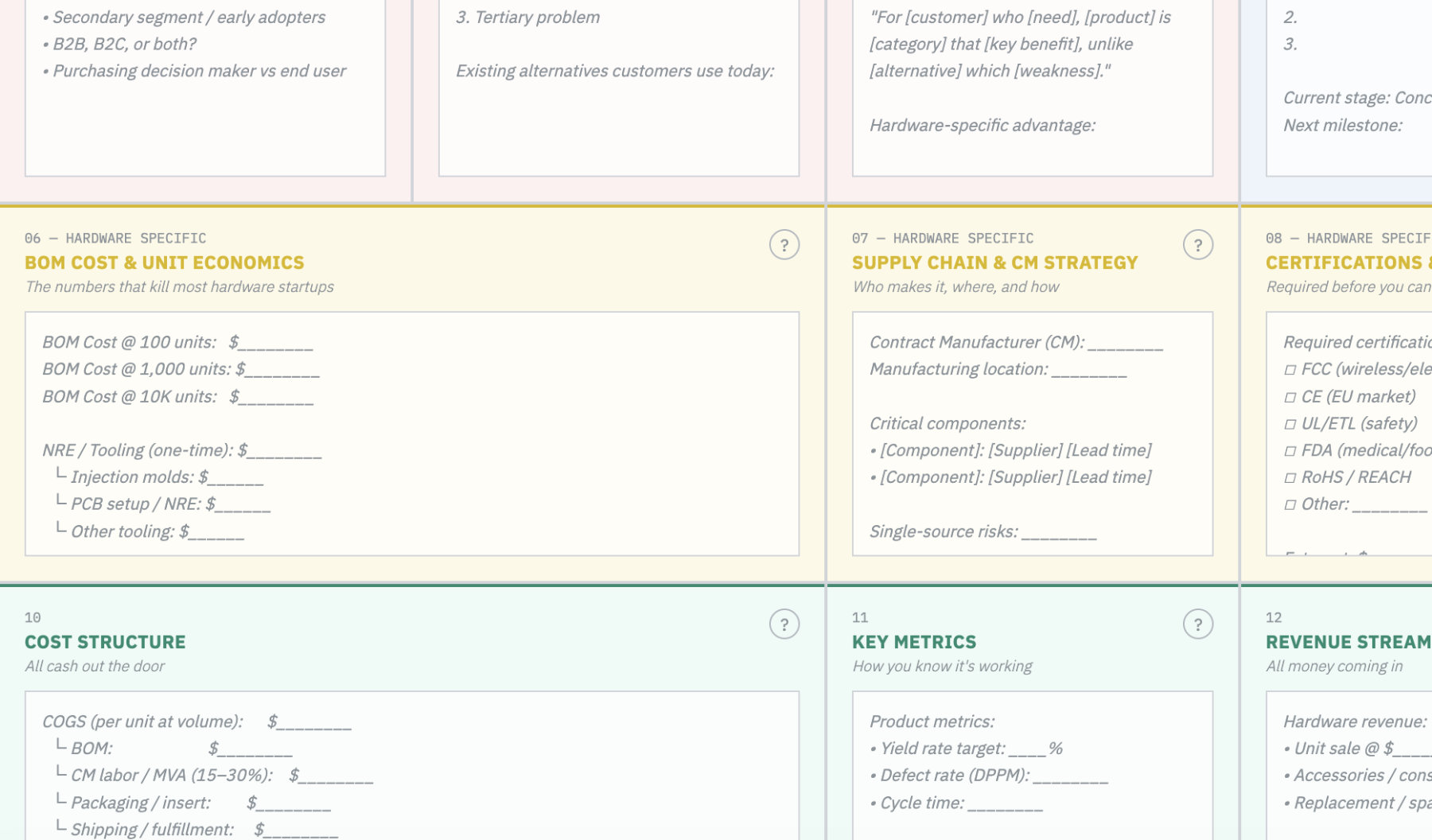
    The Hardware Startup Canvas is a 12-section strategic planning tool built specifically for physical product companies. It covers the sections most frameworks skip entirely — unit economics, supply chain and CM strategy, certifications and compliance — alongside the fundamentals every startup needs to work through.

    It’s not about slowing founders down. It’s about applying the same rigorous thinking that makes great hardware founders exceptional to the business itself.

    The Workshop

    I run a live, 2-hour working session for small groups of founders to fill out the canvas together, in real time. You leave with your biggest risks named, a 30/60/90-day plan to address them, and a free AI audit tool to use again and again.

    If you’re building a physical product at any stage, this is the exercise I wish someone had put me through earlier.

    Register for the next live workshop →

  • A Canvas Built for Hardware

    A Canvas Built for Hardware

    Hardware Startup Canvas
    hardwarestartupcanvas.com

    Running hardware accelerators in New Zealand and Austin, I watched a pattern emerge that was hard to unsee.

    The founders who came through our programs were sharp. Technically capable. Often brilliant. And they almost always had products that actually worked. What they didn’t always have was a business that worked around the product.

    The engineering problem got solved. The customer demand didn’t. The unit economics looked fine on a whiteboard, then fell apart at 500 units. The certification timeline got underestimated by six months. A channel strategy that worked for software got applied to something physical and stalled.

    These aren’t random bad luck. They’re predictable failure modes. And they show up, repeatedly, in early-stage hardware companies that haven’t built the right foundation before scaling.

    The Problem with Generic Frameworks

    Business model tools like the Lean Canvas and Business Model Canvas were built for software-first companies. They’re excellent at what they do, but hardware is a different problem.

    Software has no BOM. It doesn’t have a contract manufacturer, a certification process, or a supply chain that can be disrupted by a single component shortage. It doesn’t require you to forecast tooling costs, navigate FDA or FCC requirements, or decide between direct-to-consumer and retail distribution before you’ve shipped a single unit.

    When hardware founders try to use generic frameworks, the result is a plan that looks complete but has gaps where the hard stuff should be. Those gaps surface later. Usually at the worst possible time.

    What the Canvas Addresses

    The Hardware Startup Canvas is built specifically for physical product companies. It covers the twelve areas that matter most at the early stage, including ones that rarely appear in standard frameworks:

    Bill of Materials and unit economics. What does it actually cost to build? How does that change at 100, 1,000, and 10,000 units? The BOM is where most hardware businesses either work or don’t. It needs to be stress-tested early, not discovered late.

    Supply chain and contract manufacturing strategy. Who makes it, where, and what happens if they can’t? Single-source dependencies and long lead times are among the most common reasons hardware companies miss their windows.

    Certifications and compliance. FCC, CE, UL, FDA. Depending on what you’re building, the certification path can take months and cost more than the first prototype. Founders who treat this as a checkbox at the end often find themselves six months from launch with no clear path to market.

    These sit alongside the fundamentals — customer segment, problem, unique value proposition, channels, cost structure, key metrics, and revenue streams — all framed around the specific realities of hardware.

    Built for Clarity, Not Complexity

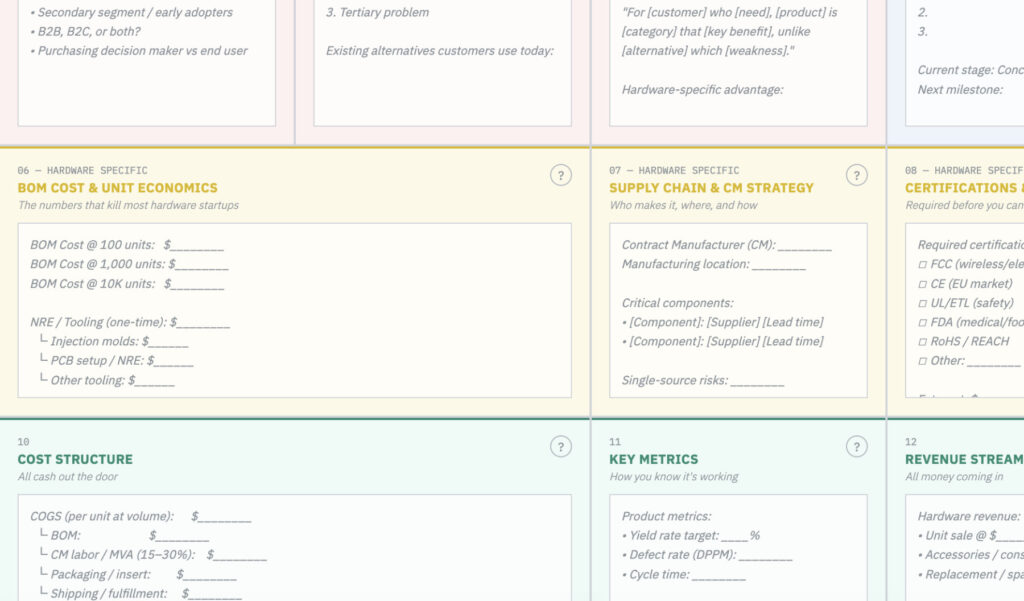
    The canvas is a single page. The goal isn’t a 40-page business plan. It’s to force the right conversations early, surface the assumptions that need testing, and give founding teams a shared view of where they are and what’s unresolved.

    It works as a starting point for a new venture, a checkpoint before a funding round, or a diagnostic when something isn’t working and you need to figure out why.

    The canvas is free at hardwarestartupcanvas.com. Fill it out in the browser, export a PDF, and/or get a formatted version sent to your inbox.

    If you’re working through it and want a second set of eyes — that’s exactly what I do at 0112 Studio.

    Update: I’ve now launched a new paid feature for the Hardware Startup Canvas — an AI audit delivered directly to your inbox. Some pretty cool insights and recommendations actually. Check it out if/when you get the chance.

  • First Thursdays

    First Thursdays

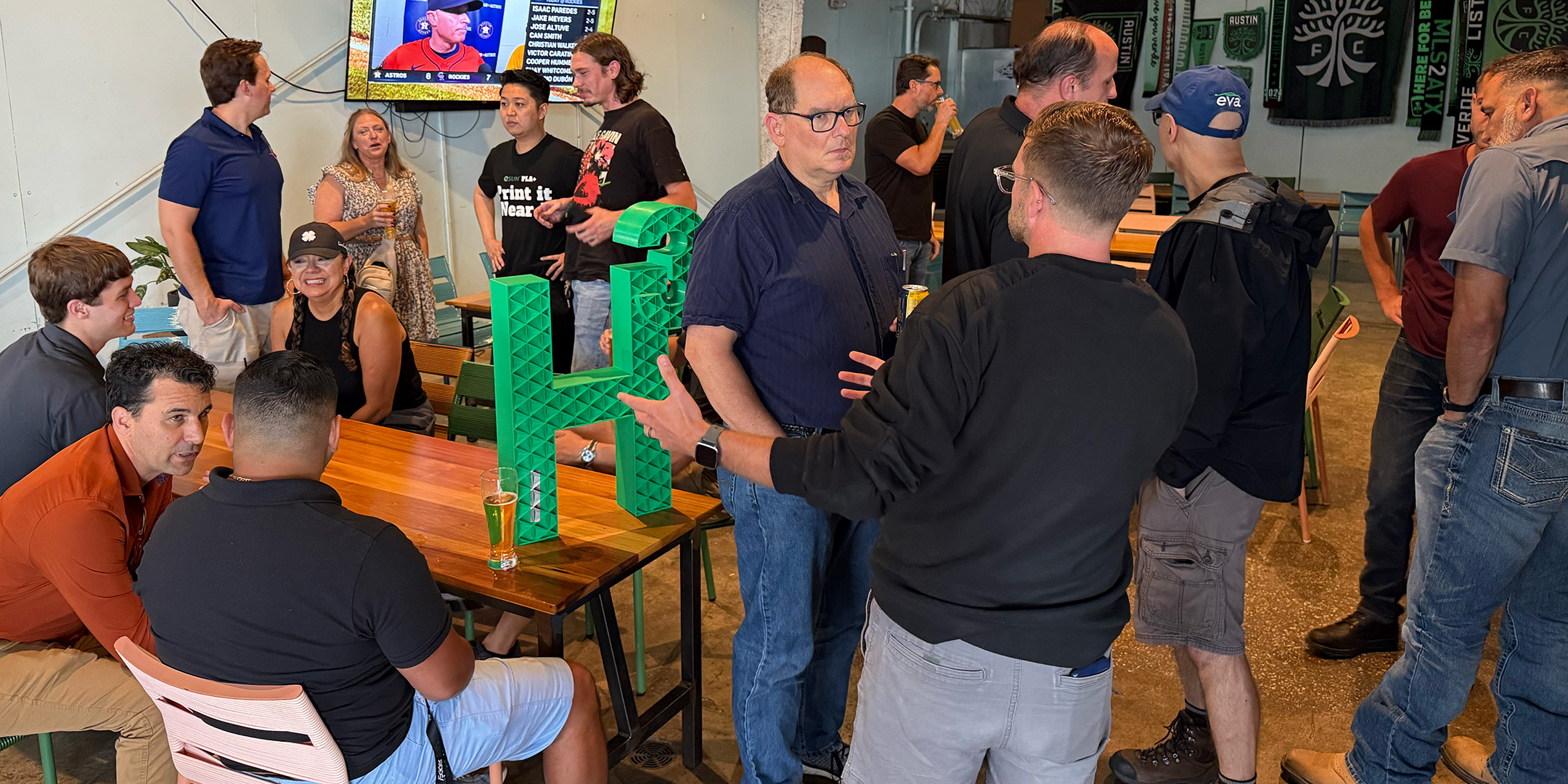
    It’s wild to think that since our very first H³ ATX event back in December 2022, Riley Knox, R. D. Childers and I have co-organized 27 hardware happy hours (if my math is correct) — each at a different venue in the Austin area.

    A huge thanks to everyone who shows up each first Thursday of the month to share ideas, swap stories, and explore what’s possible together in hardware & deeptech. Our 28th edition is this Thursday, September 4th at Meanwhile Brewing on the southeast side of town. Hope you can join us.

    For details on future events, make sure to join the H³ ATX email list. Not to worry — we’re very gentle on the old inbox.