Running hardware accelerators in New Zealand and Austin, I watched a pattern emerge that was hard to unsee.
The founders who came through our programs were sharp. Technically capable. Often brilliant. And they almost always had products that actually worked. What they didn’t always have was a business that worked around the product.
The engineering problem got solved. The customer demand didn’t. The unit economics looked fine on a whiteboard, then fell apart at 500 units. The certification timeline got underestimated by six months. A channel strategy that worked for software got applied to something physical and stalled.
These aren’t random bad luck. They’re predictable failure modes. And they show up, repeatedly, in early-stage hardware companies that haven’t built the right foundation before scaling.
The Problem with Generic Frameworks
Business model tools like the Lean Canvas and Business Model Canvas were built for software-first companies. They’re excellent at what they do, but hardware is a different problem.
Software has no BOM. It doesn’t have a contract manufacturer, a certification process, or a supply chain that can be disrupted by a single component shortage. It doesn’t require you to forecast tooling costs, navigate FDA or FCC requirements, or decide between direct-to-consumer and retail distribution before you’ve shipped a single unit.
When hardware founders try to use generic frameworks, the result is a plan that looks complete but has gaps where the hard stuff should be. Those gaps surface later. Usually at the worst possible time.
What the Canvas Addresses
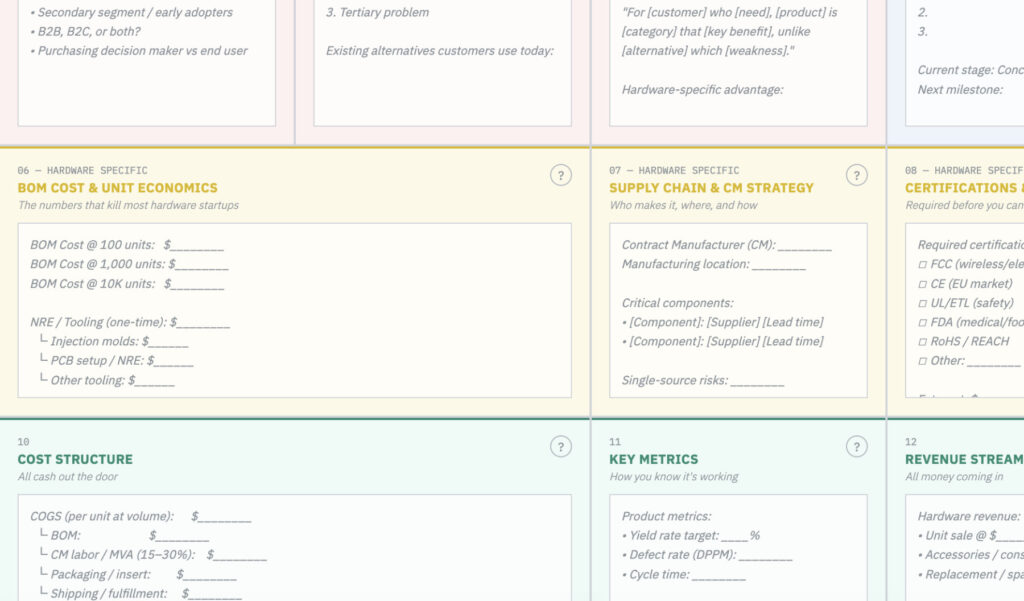
The Hardware Startup Canvas is built specifically for physical product companies. It covers the twelve areas that matter most at the early stage, including ones that rarely appear in standard frameworks:
Bill of Materials and unit economics. What does it actually cost to build? How does that change at 100, 1,000, and 10,000 units? The BOM is where most hardware businesses either work or don’t. It needs to be stress-tested early, not discovered late.
Supply chain and contract manufacturing strategy. Who makes it, where, and what happens if they can’t? Single-source dependencies and long lead times are among the most common reasons hardware companies miss their windows.
Certifications and compliance. FCC, CE, UL, FDA. Depending on what you’re building, the certification path can take months and cost more than the first prototype. Founders who treat this as a checkbox at the end often find themselves six months from launch with no clear path to market.
These sit alongside the fundamentals — customer segment, problem, unique value proposition, channels, cost structure, key metrics, and revenue streams — all framed around the specific realities of hardware.
Built for Clarity, Not Complexity
The canvas is a single page. The goal isn’t a 40-page business plan. It’s to force the right conversations early, surface the assumptions that need testing, and give founding teams a shared view of where they are and what’s unresolved.
It works as a starting point for a new venture, a checkpoint before a funding round, or a diagnostic when something isn’t working and you need to figure out why.
The canvas is free at hardwarestartupcanvas.com. Fill it out in the browser, export a PDF, and/or get a formatted version sent to your inbox.
If you’re working through it and want a second set of eyes — that’s exactly what I do at 0112 Studio.